

The problem was never the recording. It was the gap between talking and doing.
I tried the transcription apps. The ones that record your calls, generate summaries, extract action items. I believed in them for a while.
Then I stopped — not because the tools got worse, but because the entire problem they solve stopped mattering.
If you still believe recording your team meetings and processing them “somehow with AI” is the move, I have bad news: you are a couple of steps behind.
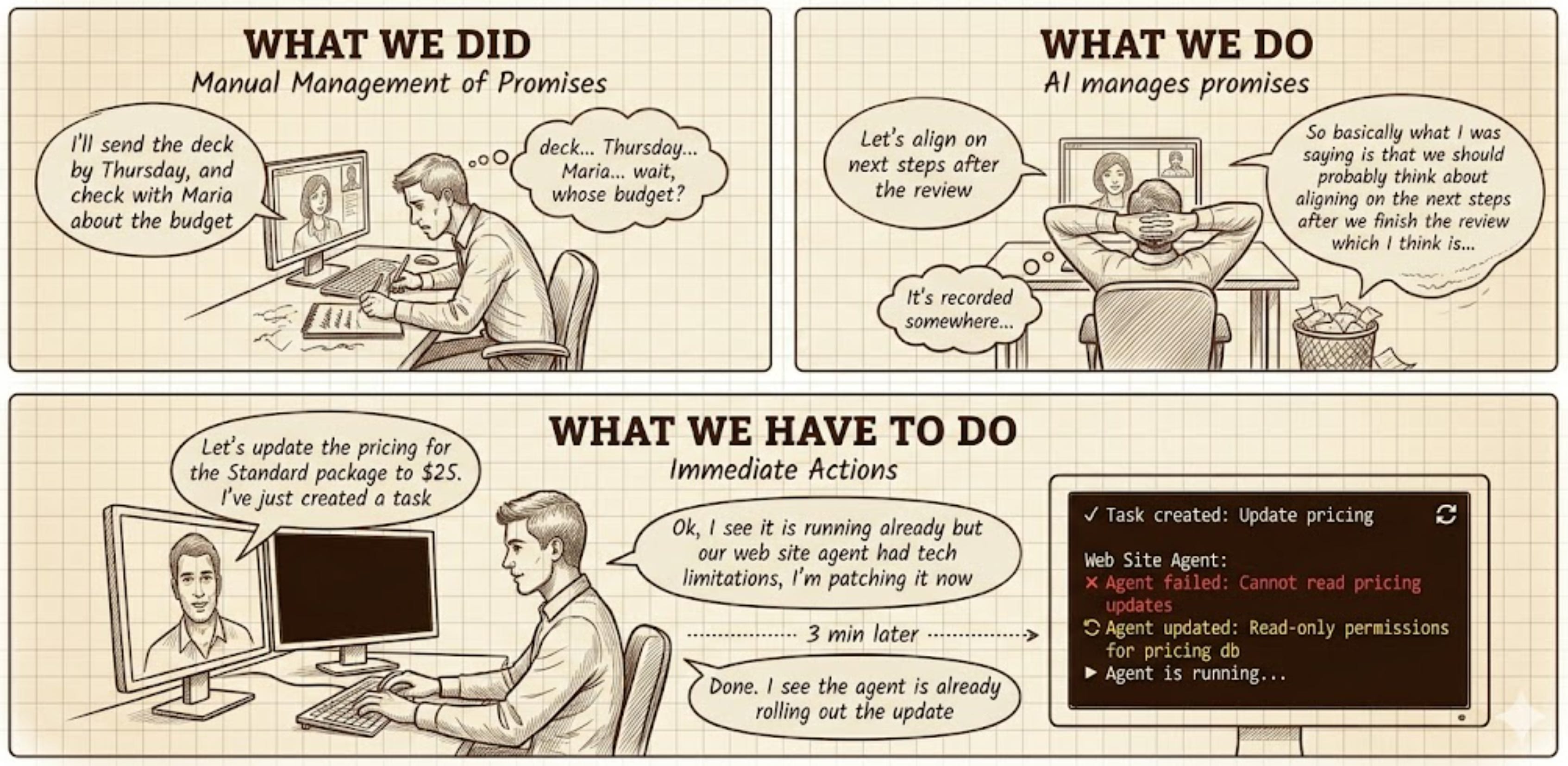
The action problem
Think about what happens after a typical meeting. Someone says “I added that to my notes.” Someone else says “I’ll schedule a follow-up.” You nod. The call ends.
Sometimes you return to those notes. Often you don’t. When you do, the context is gone — you remember the words but not the energy behind the decision, not the nuance that made it feel urgent in the moment. The organizational machinery stutters, but everyone accepts it because that is just how meetings work.
Every time, action is postponed. Postponed means delayed. Delayed means something is lost.
Transcription does not fix this. It makes the record more accurate, but the gap between “we discussed it” and “it is done” stays wide open.
Now compare that to what happens when your team works with AI agents in real time. You do not say “I will update the spec” — you say “I am currently updating the spec.” You do not say “I added that to my notes” — you say “I have already launched the change; as soon as it is implemented, you will be notified.”
The meeting itself becomes the execution environment. Not a better transcript -- a fundamentally different kind of meeting.
The privacy problem
There is a second reason transcription was always fragile, and most people avoid saying it out loud: recording changes how people behave.
When a meeting is recorded by default, everything someone says can be used as evidence later. People know this. Some are fine being wrong in front of others — they say something half-formed, get corrected, and move on. But others start filtering themselves. They feel exposed. Less professional. And you will never fully fix that dynamic, because leaders are not personal therapists. You work with humans as they are, not as you wish they were.
Now push it further. Even if your team is comfortable with group recordings — would they accept you transcribing one-on-one meetings? Every phrase. Every word. Would they truly be comfortable sharing something private, something vulnerable, knowing it is captured forever?
I asked managers about this directly. About nine months ago I posted in r/managers asking if people struggle with 1-on-1s. The responses confirmed what I suspected: the managers who cared the most about building trust were the ones most opposed to transcription. One put it simply — 1-on-1s are for talking to the person, not the title, not the role. That space only works when it feels safe. Another described action items from 1-on-1s sitting in shared docs going nowhere: “Nothing moves forward. It feels like a broken process, with missing pieces in the puzzle”. The community was fragmented across dozens of note-taking tools, all solving the wrong problem. Nobody had solved action-closing.
This is a problem you cannot fix with better transcription tools. And honestly, you probably should not try.
As AI-native collaboration reshapes how teams work together, this tension dissolves on its own. When agents handle execution during the meeting, there is less need to capture what was said — because what was said has already become what was done.
The shift
I have started paying attention to something small that changed how I think about all of this. Every time I get the automatic feeling “I need to note this down”, I pause — because I now recognize that instinct as a failure signal. It means something should have been acted on and was not. So instead of writing it down, I ask myself: why do I want to record this? Why is there no simple action to fix this right now? That one question, applied consistently, has gradually shifted how my team communicates. Less note-taking. More architecting. From people who document intentions to people who execute them.
The collaboration changes happening right now are enormous. Human-agent-human interactions bring challenges no one has playbooks for yet — and they make the old ones, like “how do we extract value from a meeting recording,” irrelevant.
That transformation deserves its own post. For today, one takeaway:
You have to finish meetings with ready-to-use results. Planned meetings. Launched changes. Not notes about what to do.