Building an autonomous system for software engineering is hard to explain quickly. Intuitively, the value feels obvious. But the difference compared to Claude Code or Codex might seem non-existent because those tools already do quite impressive things. In reality, the difference is huge. To be honest, they have only one thing in common: using an LLM for a portion of their tasks.
Quite often, I see people ignore the uncertainty that comes with these agentic coding tools. Don’t get me wrong, I am a big fan of Claude Code and Codex; they are amazing tools to launch anything you want within two hours (I am experimenting with small robotics engineering today, and the digital part looks quite impressive—that’s another topic I will share later). But the uncertainty is still there.
Imagine you are a non-technical founder getting your first clients—hundreds, maybe thousands of them. You continue tackling more and more issues, trying to manage everything, and the same problems return again and again. You hire someone technical, and either the speed drops, or the speed remains the same but your engineer tries to “Claude-code” your problems using their own communication style. Does this bring certainty? I don’t think so. More and more, our own apps are becoming black boxes nowadays. We just see different signs and react; we hope the specifications will match the result. Otherwise, we have to drop our speed and start reviewing everything from scratch, which is nonsense. Check out my other post about human-at-the-boundary replacing human-in-the-loop:

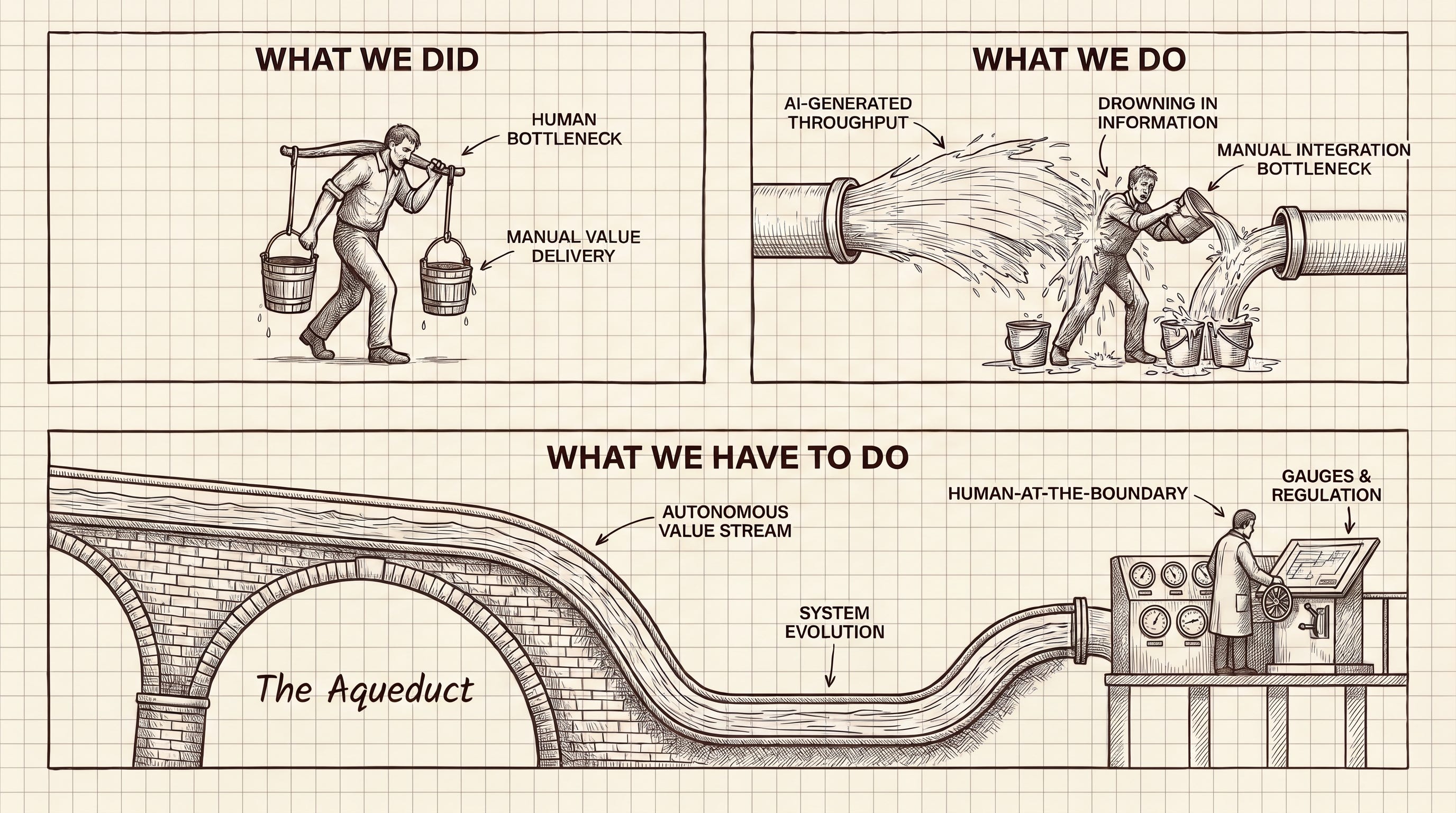
How do we bring certainty back? How do we achieve the same level of confidence we had before, while maintaining 10x productivity or more? You have to build an aqueduct.
I found the metaphor of an aqueduct when I tried to combine the most important features of any autonomous system: economic value delivery without human involvement for every single unit (connecting supply and demand), and leveraging the freed‑up space of human attention and expertise in a smarter way.
Most modern AI-powered systems are just “water pipes,” and the humans who “push water” through them today are drowning in information. People are given their old tools augmented with AI, yet they remain uncompetitive in throughput compared to the technology itself. I believe this might be the biggest mistake humanity has made in recent history. There are even echoes of the Industrial Revolution and its social missteps, when organizations were focused on getting the most out of humans.
A traditional aqueduct is a well-engineered system made for autonomous water delivery under the force of gravity. Water is sourced, transferred, and accumulated automatically. There is no need for humans to keep water in buckets or move it manually, competing with physics regarding throughput. Humans spend their resources not on the “water” itself, but on gauge monitoring, faucet control, and overall system maintenance.
The most significant aqueduct transformations happen not due to the evolution of construction technology, but due to an evolution in mindset and human knowledge about the environment where the aqueduct operates, as well as gaining deeper expertise (compare earlier aqueducts that did not consider the law of communicating vessels with later ones).
There is a rather naive idea that humans become redundant once an aqueduct is built. People are still needed, but their roles and daily work change (again, that’s a great topic for another post).
Acting as an aqueduct, an autonomous system delivers value without the need for human intervention. Features don’t need you to propose or deliver them; instead, you launch, maintain, regulate, and evolve the entire delivery system.