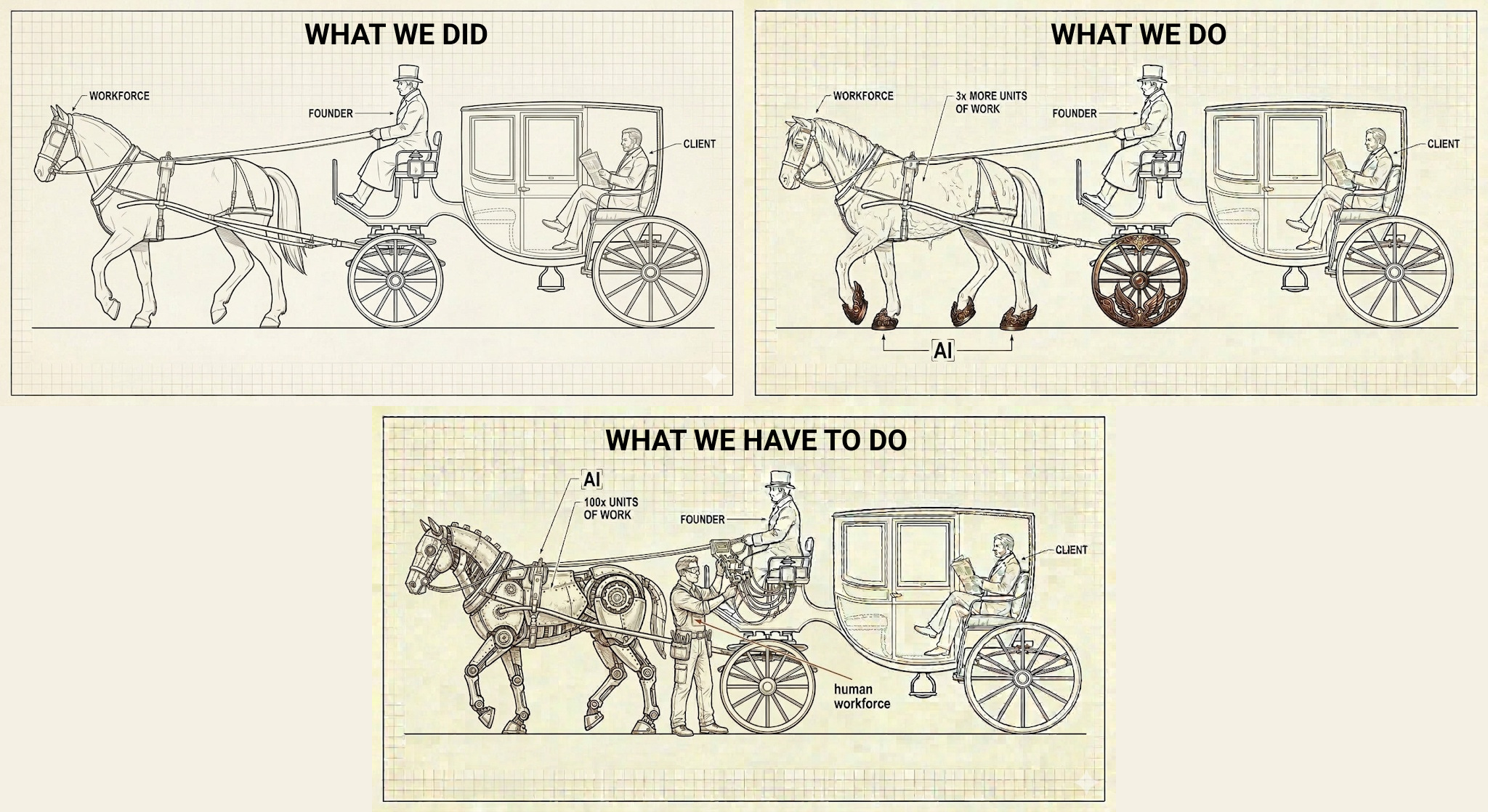
We believe that AI is changing the world, the economy, how we work — everything. And most of us want to be part of this transformation because we hope it will bring more efficiency. But there is a problem. The way most of these transformations are running is deeply wrong from almost every possible perspective. Here is why and how to fix it.
Wrong and naive idea of transformation
The frictionless way to transform one business process to another is by giving AI “superpowers” to every employee. It is exactly what we see around: “everyone uses AI,” “ask ChatGPT about this problem!,” “there is a new AI tool that solves your problem.” We empower employees with AI while expecting them to perform better — otherwise they will be “not good enough,” “not adaptive enough,” and eventually fired. Meanwhile, these are quite challenging times for every regular worker. Most “knowledge workers” (those who usually do knowledge in -> knowledge out kind of work) are scared about their jobs or at least feel uncertain. Those who cope with the emotions eventually get overwhelmed and exhausted by the permanent bombing of new tools and “AIs.” A massive pandemic of burnout is coming just because people try to do their best, but the maximum they can achieve is a 3x result compared to others — in exchange for overloaded context in their minds. 3x does not come for free. It gradually burns everyone.
The right way of transformation
We needed systems and processes to organize different people and design businesses to deliver value despite circumstances. Now those people have to move out of the value delivery chain and start looking from the outside of the value stream by designing it — actually doing proper piping instead of managing water inside the tube.
Take a software engineer as an example. The wrong transformation: give them GitHub Copilot and expect twice the output. What actually happens — they write more code, review more code, ship more bugs, and burn out faster. The intensity just went up. The right transformation: the engineer stops writing code manually altogether. Instead, every time a new task arrives, their job is to help AI understand the context, navigate the codebase, and produce better output than last time. They become the architect of AI’s understanding — not a faster AI tools orchestrator. The pipe gets smarter. The engineer gets leverage.
Founder, AI, and other human relations
This same principle — designing the pipe instead of pushing water through it — applies way beyond engineering. It applies to everyone steering a company.
In earlier times, the speed of change was slower; light steering brought you to the right result. Now times are different. With great power comes great responsibility. If you harness AI properly, your speed will be significantly higher — and it comes with higher risk because wrong steering will hit hard (think leaked data only because AI generated your MVP and security was not one of your concerns).
Take a founder as an example. The wrong transformation: use AI to ship everything faster — landing pages, pitch decks, product MVPs, legal docs — all generated in a weekend. Feels like a superpower. What actually happens — you ship fast with zero guardrails. AI hallucinates a privacy policy that doesn’t cover your actual data flows. Your MVP stores user credentials in plain text because nobody reviewed the architecture. You move at 10x speed straight into a wall. The right transformation: the founder doesn’t just use AI — they surround themselves with the right people who know where AI cuts corners. A security-minded engineer who reviews what AI generates. An advisor who flags regulatory blind spots before they become lawsuits. The founder’s job is not to do everything with AI. It is to build the team and the structure that makes AI safe to use at speed. The harness matters more than the horsepower.
Having the right people who help you build a good harness is the key. Speed without structure is just a faster way to fail.