

I wrote recently about AI transformation — about how most companies are doing it wrong, pushing water through pipes instead of redesigning the pipes themselves. Since then, I’ve watched dozens of teams try to adopt AI. And what I see now goes deeper than strategy or tooling. What I see is a belief system problem.
The shift we’re living through is not “use AI to do your work faster.” It’s “teach systems to do the work on your behalf.” That sounds like a small distinction. It’s not. It’s the difference between running harder and building something that runs without you.
We used to write code. We used to test it. We used to deploy it, monitor it, fix it, repeat. That was the job. Now the job is different — not in degree, but in kind. The people and companies who figure out how to teach programs to do this work, who find more efficient ways to drive value through their systems, win. Those who don’t lose the competition. And when systems lose, the people who depend on them lose with them.
So why isn’t everyone sprinting toward this? Because it triggers something primal.
The Fear Underneath
Our deep fear of becoming redundant shifts our focus from the productive path — teaching, architecting, designing systems of work — to the unproductive one: clinging to manual control. We don’t adopt AI poorly because we lack intelligence. We adopt it poorly because we’re terrified of what full adoption implies about our role.
If you’ve ever watched a brilliant individual contributor get promoted to manager, you’ve seen this movie before. The best ICs often make the worst new managers, and the reason is always the same: they can’t stop doing the work themselves. They micro-manage. They rewrite their reports’ code. They hover. Not because micro-management is effective — anyone with experience knows its scope of application is vanishingly small — but because letting go of the work feels like letting go of their identity. Their value was in *doing*. Now their value is in *enabling*. Yes, it’s a process change — but the identity impact is what makes it so hard.
This is exactly the struggle we’re seeing now, but at civilizational scale. Millions of knowledge workers built their professional identity around execution — writing, coding, analyzing, designing. AI doesn’t just offer to help with that execution. It offers to *replace* it. And our instinct, predictably, is to grab the wheel tighter.
The Squirrel in the Wheel
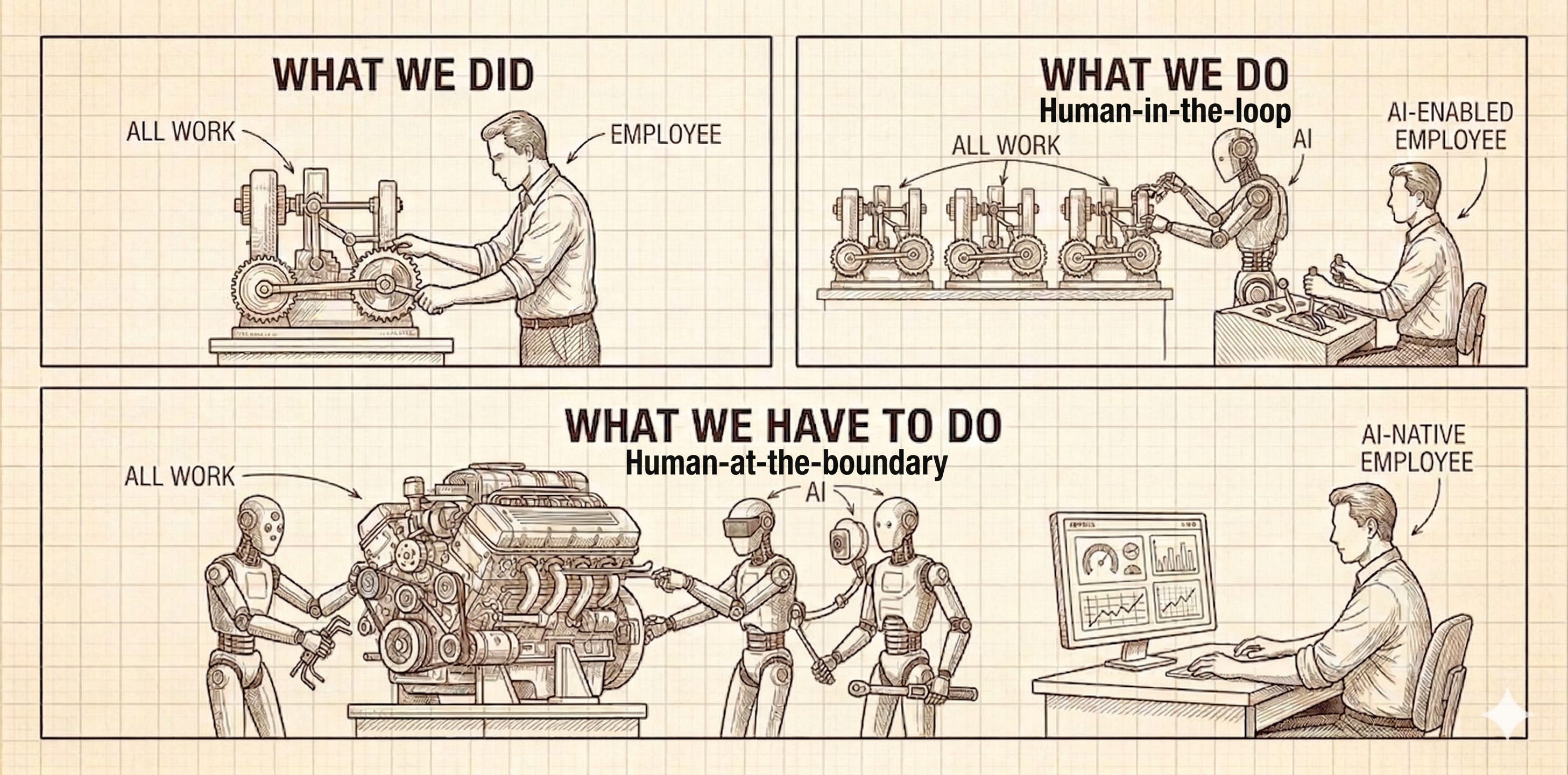
We even invented a term that reveals the dysfunction: **human-in-the-loop**. Think about what that phrase actually means. You are the squirrel in the wheel, and you’ve committed to running at whatever speed the wheel spins. As AI accelerates, you accelerate — or you fall. That’s not a collaboration model. That’s a treadmill with no off switch.
Human-in-the-loop sounds responsible. It sounds like oversight. But in practice, it means you’ve embedded yourself inside a system that will only get faster, and you’ve made yourself the bottleneck. Every output waits for your review. Every decision routes through your judgment. You feel essential — and you are, in the worst possible way. You’re essential the way a toll booth is essential on a highway: everything still flows, just slower, because of you.
The reframe I keep coming back to is this: **move from human-in-the-loop to human-at-the-boundary.**
Human at the Boundary
The difference is fundamental. A human in the loop operates inside the system — reviewing, approving, correcting, running alongside the machine at machine speed. A human at the boundary operates outside the system — defining what it should do, setting the constraints it must respect, architecting how value flows through it, and intervening only when the system encounters something beyond its boundaries.
The human at the boundary doesn’t review every pull request. They design the testing framework, the guardrails, the acceptance criteria — and then they let the system run. They don’t approve every marketing email. They define the voice, the rules, the audience parameters — and then they audit outcomes at the edges, where the interesting failures happen.
This is what it means to build systems of autonomous value delivery. Not “AI does everything unsupervised.” Not recklessness. But a fundamentally different relationship with work, where your job is to architect the system’s intelligence rather than substitute for it.
Those who build these systems — who design their work as autonomous pipelines with human judgment at the boundaries, not embedded in every step — are the cohort that will survive and succeed. Everyone else will eventually learn from them. But that learning will come with a collision with ground truth: the single certainty right now is uncertainty, and the people who build adaptive systems will navigate it better than the people white-knuckling their way through every task.
Redundancy Is the Point
Here’s the part nobody wants to hear: redundancy is not the threat. Redundancy is the goal.
Every time you make yourself redundant in one area of work, you free yourself to operate at a higher level. The IC who becomes redundant as a coder becomes available as an architect. The manager who becomes redundant as a task-assigner becomes available as a strategist. This has always been how careers advance — you outgrow the work, hand it off, and move to the harder, more leveraged problem above it.
AI just compressed the timeline. What used to take years of gradual delegation now happens in months. The IC doesn’t slowly hand off coding to junior developers over a decade. They hand it to AI next quarter. That speed is disorienting. It feels like loss. But the opportunity on the other side is enormous — not despite the redundancy, but because of it.
As soon as you stop fighting redundancy and start embracing it, the opportunity space explodes. There is more work to do than ever before — it’s just different work. Higher-leverage work. The work of teaching, designing, architecting, and steering systems that deliver value at a scale no individual human ever could.
The belief system shift is simple to state and brutal to internalize: your value is no longer in what you do. It’s in what you enable. The sooner you make peace with that, the sooner you start building.